

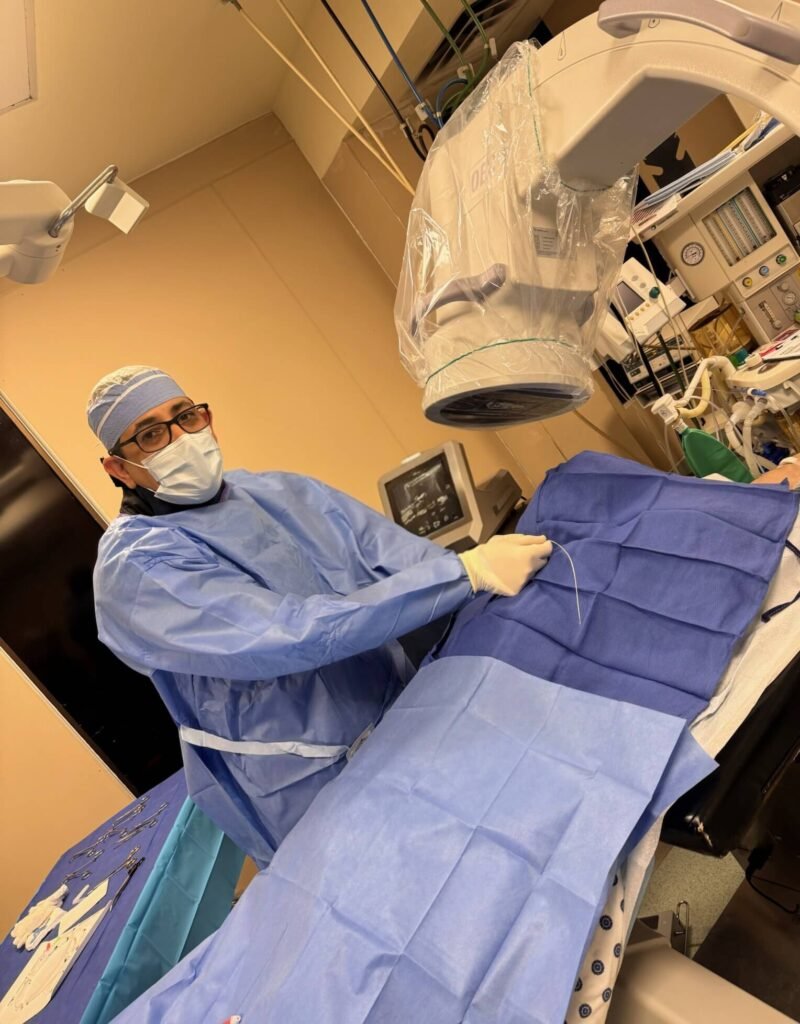
What Is a Fluoroscopy-Guided Injection?
A fluoroscopy-guided injection is a minimally invasive procedure used to diagnose and treat pain. Using real-time X-ray imaging, your provider delivers a precise mixture of a corticosteroid and a local anesthetic directly into the targeted joint or spine area. This ensures accurate needle placement.
Conditions Treated with Fluoroscopy-Guided injection:
- Arthritis and Joint pain
- Bursitis
- Back pain
- Neck pain
- Sciatica and radicular pain
- Tendinopathies
- Muscle pain
- Neuromodulation Procedures (Spinal Cord Stimulator Trial & Implant)
Preparing for a Fluoroscopy-Guided Injection
- You will be asked if you have any allergies to medications, anesthetics, contrast dye, or latex.
- Inform your physician about all prescription medications, over-the-counter drugs, vitamins, and supplements you are taking.
- You may need to temporarily stop certain medications such as blood thinners or anti-inflammatories for several days before the procedure, if advised.
- Notify your doctor if you are pregnant, may be pregnant, or have medical conditions such as asthma or diabetes.
- Avoid alcohol and tobacco for a few days prior to your appointment.
- Do not eat or drink for at least eight hours before the procedure if sedation will be used.
- Remove all jewelry, watches, eyeglasses, or any metal objects that may interfere with imaging.
- Arrange for someone to drive you home after the injection.
- Sign the consent form once the procedure, benefits, and potential risks have been fully explained.
Preparation for Fluoroscopy-Guided Injection
In general, pre-procedure preparation for fluoroscopy-guided injections will involve the following steps:
- You will be asked if you have allergies to medications, anesthesia, contrast dye, or latex.
- You should inform your doctor of any medications, vitamins, or supplements that you are taking.
- You may need to refrain from vitamins, supplements, and medications such as blood thinners and anti-inflammatories a week prior to the procedure.
- It is also important to inform your doctor if you are pregnant or might be pregnant, diabetic, asthmatic, or have any other medical conditions.
- You should refrain from alcohol or tobacco at least a few days prior to the procedure.
- You should not consume any solids or liquids at least 6 hours prior to the procedure.
- You should remove all metal objects and accessories such as eyeglasses, jewelry, watch, etc. as they can interfere with the imaging.
- You should arrange for someone to drive you home after the procedure.
- A written consent will be obtained from you after the pros and cons of the procedure have been explained in detail.
Preparing for a Fluoroscopy-Guided Injection
- Reviewing any allergies for medications, anesthetics, contrast dye, or latex.
- Informing your physician about all prescription drugs, over-the-counter medications, vitamins, and supplements you take.
- Temporarily stopping certain medications, such as blood thinners or anti-inflammatories, several days before the procedure if advised.
- Notifying your doctor if you are pregnant, may be pregnant, or have medical conditions like asthma or diabetes.
- Avoiding alcohol and tobacco for a few days prior to your appointment.
- Not eating or drinking for at least six hours before the procedure.
- Removing jewelry, watches, glasses, or any metal objects that could interfere with imaging.
- Arranging for someone to drive you home after the injection.
- Signing a consent form once the procedure, benefits, and potential risks have been clearly explained.
How the Procedure Is Performed
- Fluoroscopy-guided injections are minimally invasive and typically completed in an outpatient setting within 20–30 minutes. Although every case is unique, the process generally includes:
- You will be positioned on the procedure table depending on the area being treated.
- Sedation may be offered to help you relax.
- The skin over the injection site will be cleaned with an antiseptic solution and covered with a sterile drape.
- A local anesthetic will be injected to numb the area.
- Using fluoroscopic (real-time X-ray) guidance, your physician will place a needle and inject a small amount of contrast dye to confirm precise positioning.
- Once the location is verified, the medication (local anesthetic with or without a steroid) will be delivered to the targeted area.
- The needle is removed, and a small bandage is applied.
Post Procedure Care
After the procedure, you will be monitored for a short period before going home. Post procedure care may include:
- Staying in the recovery area for about 15-30 minutes to observe for any reaction.
- Expecting mild pain or soreness at the injection site for a few days and using ice packs or medications as recommended.
- Avoiding driving or operating heavy machinery for at least 24 hours if you received sedation.
- Attending your follow up visit to monitor your progress.
Risks and Complications
Fluoroscopy-guided injections are a relatively safe procedure; however, as with any procedure, some risks and complications may occur, such as:
- Pain
- Numbness
- Infection
- Bleeding
- Damage to adjacent tissue
- Soreness/bruising
- Allergic/anesthetic reactions